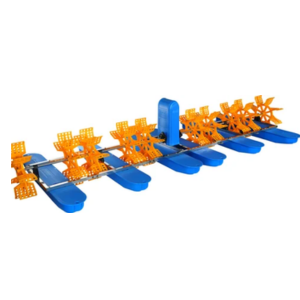
Paddle Wheel Aerator for shrimp farming
A paddle wheel aerator for shrimp farming is a reliable shrimp pond oxygen machine that increases dissolved oxygen (DO) by creating strong surface agitation and water circulation. This machine to increase oxygen in shrimp pond helps maintain healthier water, supports better feed activity, and improves survival in intensive and semi-intensive ponds. It also works as an effective prawn pond water oxygen system for brackish and freshwater culture.
Built for intensive shrimp pond environments, our high-efficiency shrimp farming paddle wheel aerator uses powerful rotating paddles to maximize surface agitation and oxygen diffusion. It ensures uniform water movement, reduces stagnant “dead zones,” helps prevent thermal stratification, and supports a healthier microbial balance—important for stable pond conditions and consistent shrimp growth.
If you’re looking for an oxygen machine for shrimp farming that is easy to install and dependable for daily farm use, this shrimp pond paddle wheel aerator is ideal for commercial operations.
Shrimp farming Ponds with Paddle wheel Aerators had lower water temperatures by 3%. paddle wheels aerators can increase net crop value by 40% and lower the operating costs. Float Aerator.
| Minimum Order Quantity | 1 Piece |
| Motor Phase | 3ph |
| Usage/Application | Aquaculture |
| Brand/make | SYNERGY AQUAPRO |
| Air flow Rate (m3/h) | 3 (m3/h) |
| Treatment Technique | Clarifier,Fluidized Aerated Reactor |
| Service Area (m2) | 0.25 m2,1 m2,5 m2 |
| Model/Type | 2HP – 4 PADDLE |
| Oxygenate Capability (kgO2/h) | 0.13 (kgO2/h),0.25 (kgO2/h) |
| Bubble Diameter | 3 mm |
| Float Weight | 6.5 kgs Double Layered |
| Automation Grade | Automatic |
| Type Of Aerator | Surface Fixed |
| Voltage | 415 |
| Power Consumption | 2.5 Amps |
| Weight | 100 kgs |
| Brand | SYNERGY AQUA SUPPLIERS |
| Application | Waste Water Treatment |
| Motor | 2 kw |
| Color | Blue |
| Motor Power | 2HP |
| Warranty | 1 year |
| Type of Aerator | Surface Floating |
| No. of Paddle | 4 |
- High oxygen transfer rate for faster shrimp growth
- Strong water circulation to eliminate dead zones
- Corrosion-resistant paddles built for saline water
- Low-noise, energy-efficient motor for continuous use
- Heavy-duty floatation ensures stability in operation
- Available in solar-powered & variable-speed models
- Quick installation & minimal maintenance
- Compatible with freshwater and brackish ponds
- Suitable for freshwater and brackish ponds as a prawn pond water oxygen system
1. Superior Oxygen Transfer
Helps maintain consistent DO levels during peak stocking, reducing shrimp stress and mortality.
2. Active Pond Circulation
Keeps your pond uniformly mixed, reducing sludge buildup and toxic zones.
3. Energy-Saving Design
Optimized for high output at low wattage—reduces your monthly power bill.
4. Built to Last
Made with HDPE, stainless steel, and saltwater-resistant coatings.
5. Flexible for Any Setup
Choose from 1HP to 3HP models to suit traditional, semi-intensive, or intensive ponds.
1. How does a paddle wheel aerator for shrimp farming improve dissolved oxygen?
A paddle wheel aerator increases dissolved oxygen by splashing and agitating the pond surface, enhancing oxygen transfer from air to water, which is essential for maintaining healthy shrimp in intensive farming systems.
2. What is the ideal paddle wheel aerator size for a shrimp pond?
The ideal size depends on pond area and stocking density. Typically, shrimp farmers use 1HP to 2HP paddle wheel aerators for medium ponds, while larger and intensive ponds may require multiple units or higher horsepower models.
3. How many paddle wheel aerators do I need for shrimp farming?
A common rule is 1 horsepower of aeration for every 300–500 kg of shrimp biomass. The required units depend on stocking density, pond depth, and feeding load.
4. Are paddle wheel aerators energy-efficient for shrimp culture?
Yes. Modern paddle wheel aerators are designed for low power consumption and high oxygen transfer efficiency, making them one of the most energy-efficient aeration solutions for shrimp farms.
5. Can I use a solar-powered paddle wheel aerator for shrimp farming?
Absolutely. Solar paddle wheel aerators are increasingly popular in aquaculture as they reduce operating cost and provide sustainable aeration—especially in off-grid shrimp ponds.
6. How often should I run a paddle wheel aerator in a shrimp pond?
Most farmers run aerators during the night when DO levels drop, and especially from late evening to early morning. In high-density ponds, continuous or scheduled aeration may be required.
7. Does a paddle wheel aerator help control ammonia in shrimp ponds?
Yes. By improving water circulation and oxygen levels, paddle wheels enhance microbial activity that breaks down ammonia and other harmful compounds.
8. Do shrimp need an aerator?
Yes—especially in semi-intensive and intensive farming. Aeration keeps dissolved oxygen stable and helps prevent sudden DO drops at night or after heavy feeding.
9.Will an aerator keep shrimp alive?
An aerator greatly improves survival by preventing low-oxygen stress, but pond health still depends on stocking density, feeding, water exchange, and proper management. A shrimp pond paddle wheel aerator is one of the most effective tools to reduce oxygen-related mortality.
10.how to increase oxygen in shrimp pond?
Run aerators during low-DO hours (often night/early morning), add enough HP for biomass, position units to remove dead zones, and avoid overfeeding. Using the right machine to increase oxygen in shrimp pond (like a paddle wheel) is a fast and practical solution.
11. Do shrimp need high oxygen?
Yes. It is essential to maintain adequate DO in pond water for growth and survival. An oxygen concentration exceeding 5 mg/L is generally recommended for shrimp culture.